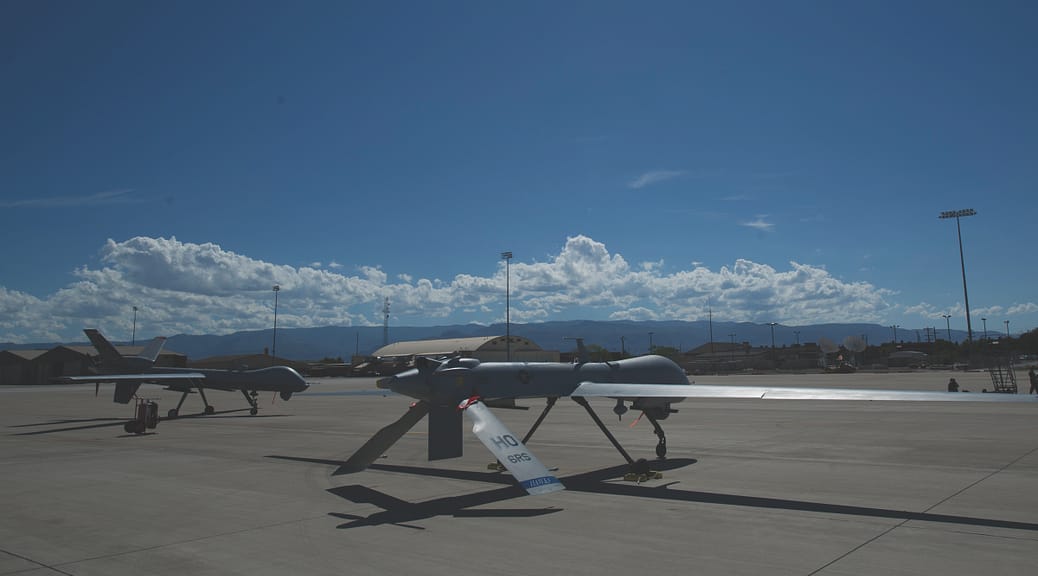
Remotely Piloted Aircraft and the Sky Above Us
To be clear: They are not drones.
Drones are spidery-looking things that, with various attachments, are capable of taking aerial photographs, allowing neighbors to spy on each other’s backyard parties, and, in the near future, maybe delivering merchandise to doorsteps.
The Air Force does have drones but they are used as aerial targets.
The MQ-1 Predator and M-9 Reaper are remotely piloted aircraft (RPA). Not drones.
The distinction is important since a drone carries connotations of a device that is operated with minimal human control. According to 2nd Lt. Travis Schirner, 49th Wing Public Affairs Officer for Holloman Air Force Base (AFB), there is little that is unmanned in RPAs.
“There is not a human soul on board but there is so much human involvement that goes on behind the scenes,” Schirner explained. “On the other hand, drones or target aircraft are piloted electronically. They fly over test ranges and then get blown up or get shot at for weapons testing.”
An Air Force RPA mission requires close to 200 people, including those remotely flying the aircraft, as well as intelligence, maintenance, communications and launch and recovery personnel.
The 49th Wing’s primary mission is to train the world’s best RPA pilots and sensor operators.
While still in a nascent stage, the program has grown exponentially.
“The kind of training we do is not unique to Holloman, but we are the biggest and the only active duty Formal Training Unit,” Schirner said.
Schirner also emphasized that Holloman is a training facility, unlike Beale, Creech and Cannon AFBs which are active-duty operational units. Crews from Air National Guard bases in North Dakota, New York and Ohio also carry out what are referred to as deployed-on-station missions.
All branches of the military use RPAs, but qualifications and training differ. In the MQ-1 and MQ-9, officers fly and enlisted personnel are sensor operators. Until 2010, only manned-aircraft pilots could be trained to fly RPAs, but, with the added demand, an RPA pilot career path was developed, eliminating this prerequisite.
This is not to say that pilots are nothing but glorified video-gamers, a common misperception.
RPA training takes approximately 10 months. The first portion of RPA pilot training is the same as traditional pilot training and takes place in Pueblo, Colorado. Pilots in the remote pilot training typically log 40 hours over seven weeks flying a glider-like DA-20 Diamond. This is the only manned aircraft flying future RPA pilots will experience. Flight training at Pueblo emphasizes cross country flying.
The next phase takes place at Randolph AFB in Texas and includes classes in instrument reading and simulator flying involving low-level exercises in a manned-aircraft simulator. Randolph also trains sensor operators in camera and laser usage and weapons training. Once a weapon is fired, it is the sensor operator who guides it to the target.
Holloman AFB then provides more specific simulated and real-world training for the MQ-1 and MQ-9 aircraft.
The last two weeks of training are dedicated to working with other branches of the military in joint exercises.
In addition to the skills required of an officer, pilots need to be smart, quick-witted and intelligent. Both pilots and sensor operators must also be comfortable with the ever-changing face of technology. Studies by Professor Henry Jenkins of the Massachusetts Institute of Technology (MIT) point to the need for “21st century job skills,” such as instruction in data analytics, visualization, mapping, programming, math and artificial intelligence, for those interested in the field.
“The crew is doing a lot of calculations on the fly,” Schirner said. “Even in the simulators, the sensor operator is getting coordinates and the pilot is writing them down on a whiteboard. For the pilot, leadership is key because you are leading a crew.”
Communication is crucial. The pilot must be able to talk to the sensor operator and vice versa, despite differences in rank, and both must be able to relay what they are seeing on a monitor to those on the ground. At Holloman, the Air Force simulates possible interactions of Air Force pilots in the air and Army troops on-site.
Pilots also have the ability to consult military legal experts and, in some cases, the commander of the theater.
“It is not just a pilot saying: ‘I’m going to take this target out,’” Schirner said. “The pilot has the final decision, but really it is a well-calculated decision based on what the guys on the ground are saying.”
Communication extends beyond the base itself since pilots are capable of remotely handing aircraft or swapping positions over to other pilots at other operational units. This continuity is crucial since RPAs are in the air 24/7. Crews typically work ten- to twelve-hour days. The ability to continually fly aircraft remotely from bases in the United States means that fewer personnel are needed to be stationed overseas and changes in geographical locations can be made without the onerous physical relocation of personnel and equipment.
In addition to precision strikes, RPAs are used for intelligence, reconnaissance and surveillance. The MQ-1 and MQ-9 are equipped with missiles, lasers that can pinpoint targets for manned aircraft and sensors that can locate improvised explosive devices (IEDs) and insurgents. They also watch over U.S. soldiers on the ground.
“When compared to manned platforms, RPAs are as safe or safer in terms of limiting collateral damage because they are so precise,” Schirner said. “They have the ability to loiter in air for such a long time compared to conventional manned platforms, which allows pilots to make better decisions.”
Long periods waiting and observing are interspersed with intense bursts of adrenaline-stoked action requiring quick life-or-death decisions. The dichotomy is exacerbated as the crew ends a shift in an operational theater overseas and returns to civilian life at home.
The stress of the job has taken its toll on recruitment and retention efforts, with an attrition rate three times that of traditional pilots according to a policy paper written by Col. Bradley T. Hoagland for the Brookings Institution. (See https://www.brookings.edu/research/manning-the-next-unmanned-air-force-developing-rpa-pilots-of-the-future).
In addition to long hours, constantly rotated shifts result in disrupted sleep patterns and time spent with families. RPA personnel also often remain on assignment for longer periods. Pilots may be expected to fly for six years while other officer assignments might last only three to four years. In interviews conducted by the Government Accountability Office (GAO) for a report to Congress in April 2014, some pilots were under the impression that they would be able to return to their original manned assignment that had a clear end point but, instead, until recently, were kept in the RPA program for indefinite amounts of time.
For new recruits, many do not fully understand the RPA mission, and there are few experienced pilots who are able to mentor. Cargo and jet pilots, reservists and even instructors are being pressed to go back to work as RPA pilots to meet increased demand. To add insult to injury, there is a stigma within the Air Force that RPA flying is subordinate to manned aircraft flying.
The second-class perception was inadvertently reinforced when Secretary of Defense Leon Panetta approved the Distinguished Warfare Medal in 2013 only for Secretary Chuck Hagel to overturn the distinction in favor of a different “type” of recognition later that year.
According to Col. Hoagland, this dismissive attitude is a factor for a lower promotion rate for RPA pilots, made more elusive since what goes on during missions is often classified information.
The GAO report also studied how the Air Force manages its RPA pilots and their quality of life, defined as morale, health and wellness, work-life balance and promotion rates.
The report found that the Air Force did not adequately anticipate the number of pilots required. It also failed to take into account time needed for crews to attend briefings and perform administrative and launch and recover tasks. These omissions, in turn, resulted in an underestimation of the number of pilots the Air Force initially needed.
Personnel demands are calculated on the number of combat air patrols (CAPs), a level directed by the Secretary of Defense, and based on the number of RPA crews required for one 24-hour flight. In 2010, the Secretary of Defense was urging the Air Force to reach 65 CAPs by 2013, which would require between 1,600 and 1,650 pilots. However, by the end of the year, the total was only 1,366. In April 2015, the number of CAPs was reduced by five to 60 in an attempt to reduce the stress being voiced by RPA personnel, a goal confirmed in a February 9, 2016 article in “AirForce Times” by Philip Swarts. A month later, in the same publication, however, Swarts reported that Chief of Staff Gen. Mark Welsh told reporters that the number of RPA flights would increase to 70 within the next 12 to 18 months. Gen. Welsh acknowledged the stress on pilots and placed the onus on training.
The Air Force responded to the GAO report and has fully or partially acknowledged the identified problems and is re-analyzing and establishing minimum crew ratios, developing a recruiting program and is considering feedback from RPA pilots. As to the recommendations of looking to other sources for pilots and including how RPA pilots are promoted, the Air Force partially concurred. As far as determining whether being deployed-on-station has negative effects, the Air Force pointed out that numerous studies have been conducted. It further requested that the focus be shifted on how to mitigate those effects rather than merely identifying them.
It remains to be seen how these recommendations play out, but, in the meantime, Holloman AFB remains committed to training RPA recruits and trying to keep up with demand.
Initial projections for 2016 fiscal year estimated 818 pilots, including both active duty and reserves, according to Schirner. The MQ-1 Predator is being phased out in favor of the newer MQ-9 Reaper that allows for about 50 percent greater range and over eight times the payload.
The question remains if Air Force remedies will be enough, given not only the increasing demand but the unique nature of the missions themselves. As documented in the GAO report, the Air Force projects that pilots will make up 90 percent of the RPA workforce by 2022. Its difficulty in not achieving its goals today has important and potentially grave consequences for the future.
“The RPA enterprise is still trying to find its legs. It had to grow so quickly that it hasn’t had the time to mature like other programs have,” Schirner said. “No one knows how many we can comfortably train. But the demand is strong, and there is an effort underway to test that limit.”