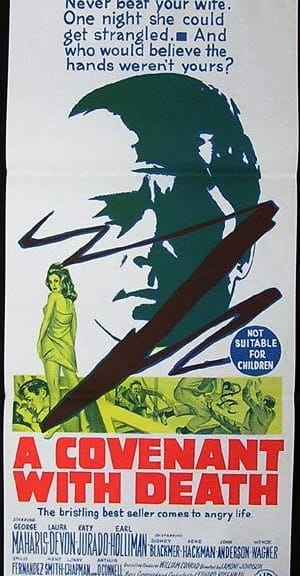
Law, Justice, and the Scaffold: A Deep Dive into A Covenant with Death
“A Covenant with Death” (1967), starring George Maharis, Laura Devon, Katy Jurado, Earl Holliman and Gene Hackman. Directed by Lamont Johnson and based on a novel by Stephen Becker. Filmed in Santa Fe.
Not rated.
Although it has the feel of a made-for-TV movie, “A Covenant with Death” deals with an interesting legal question. A man, wrongly convicted in a murder, inadvertently kills one of his hangmen trying to get away and then another man confesses to the original murder. Is the second death murder, too, or self-defense?
The movie takes place in New Mexico in 1923. Hangings did take place during that time period, but they were quickly losing favor as a form of capital punishment. Having just achieved state status a few years before, the “Wild West” is the backdrop of the story. So is race. The judge in the second trial is a young man whose mother is Mexican (played by a Katy Jurado) and whose late father was Welsh. The pre-dominant white population of Soledad City is wary of the young Hispanic judge and his ability to render a decision. His personal life is torn between a white, blond woman and the daughter of a Mexican-American rancher, with his mother as the ultimate judge and foil to his impetuous and passionate behavior.
Author Stephen Becker was educated at Harvard and studied in Peking and Paris. He went on to become a college professor and translated several works including Elie Wiesel’s “The Forgotten” and “The Conquerors” by André Malraux. In his novel, Soledad City is “…a queer sort of town, part frontier, part plantation, part pleasure, part cruelty, part Old Mexico, part clanking modernity, and, as noted, part murder.” The town is multi-racial in the book, but not in a good way. The judge’s clerk is duly noted as being “ex-Zuñi…one hundred percent American.” Another character is Geronimo Goldman, “who describes himself as the last Jewish Apache.” His first name is actually Bernard, and he is from Newark, having moved west for his health and love of Indian culture.
The mixing of cultures in the book and movie is curious. That George Maharis, who parents were Greek, plays the Hispanic judge and Jose De Vega, whose parents were from the Philippines, plays the clerk and children are running around in serapes on an obvious fabricated set that looks more Old Mexico than New is off-putting. With so many subplots and contexts the original legal question becomes lost so that, at the end, when the judge renders his eloquent verdict, the surprised response by the townspeople (a populace described as “…vicious or inadequate or uncomprehending or indifferent…” in the book) seems to imply that his decision was the result of his maturing rather than anything explicitly racist. Perhaps Becker’s worldly exploits, East Coast academic foundation and objective approach distances him from the realities of living in the Southwest, but applying a single legal quandary, no matter how interesting, to present (and translate) a variety of peoples is to succumb to the melting pot version rather than accepting and appreciating the untarnished uniqueness of the individuals involved.
Reviews are based on lectures during a traveling ENMU-Ruidoso’s Community Education series on movies partially or totally filmed in New Mexico. The films span various times and represent many genres. The only thing they have in common is New Mexico, whether landscape, history, characters and/or distinctive events. Many of the movies are forgotten; some are better known. Some are good; others are terrible but all reflect some aspect of living here.