Kinetic Kids Earn Their Name
Taking one step requires the coordinated use of 200 muscles. Forty are required to lift a leg and move it forward. Since skiing is a gliding sport, the number of muscles necessary is considerably fewer. It is an important distinction according to Kacey Wernli, co-founder and executive director of Kinetic Kids, a San Antonio, Texas organization that provides health, recreation and educational services for children with physical and cognitive disabilities and the impetus for their trips to Ski Apache.
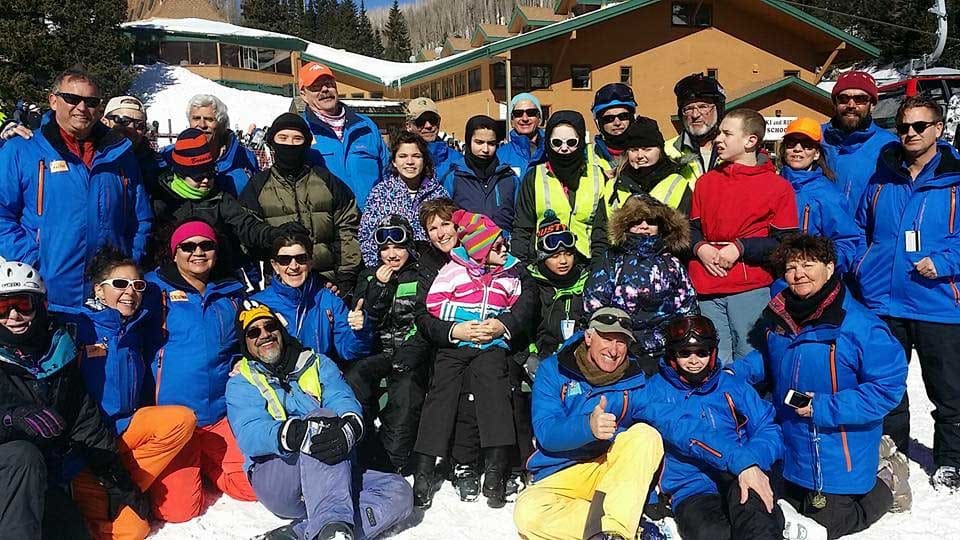
A group of 57 people including 12 of those children, their families and friends came to Ruidoso to ski with the Ski Apache Adaptive Sports (SAAS) program over the Martin Luther King, Jr. holiday. It is the ninth year that Kinetic Kids has paired up with SAAS. This is the first year the organization will be bringing two groups over two different weekends to ski.
“I am friends with one of the patrolmen at Ski Apache,” explained Wernli. “As a physical therapist, I worked with his child. I came out and met Marty Davenport who was director of the then Ski Apache Disabled Sports program and he encouraged me to bring out some of our kids. We brought out six children the next year. We went from bringing six kids to 10. Marty said: ‘I think we can teach 12.’ For the past four years we’ve been bringing 12, and this year we will bring a total of 24.”
Half of the children this year have skied before; half are coming for the first time.
Kinetic Kids offers programs including T-ball, swimming, gymnastics, soccer, basketball, dance and music programs.
“What makes Kinetic Kids unique is that the children are not only in a program where they are safe and successful, but the therapists are overseeing them to make sure that the activities are appropriate for their strengths,” said Wernli.
Skiing is often the first sport some of children experience and, for those over the age of eight and who can endure two days of strenuous activity, the experience can be life-altering.
“Kinetic Kids came about when Tracey Fontenot, another physical therapist, and I saw children come to therapy who wanted to participate in sports,” Wernli said. “We’d have to tell them: ‘Sorry, no such programs exist.’ We had the idea of starting a T-ball league that we started in 2001. We had the idea of using sport to get children from a wheelchair to a walker and to physically motivate them.”
However, Wernli and Fontenot began noticing other ancillary benefits.
“What we saw is that they came alive,” Wernli said. “Their social interaction improved. These are kids who typically do not get picked for teams at school, and they don’t have a lot of extracurricular activities. Not only were the children excited to be there, they were more motivated in other areas of their lives as well.”
Parents, too, came alive.
“They had never been a team mom. They felt like they were put in a box when their child was born, being told that their child would never play sports,” Wernli said.
Todd Wyckoff who brought his son, Cory, and an entourage of nine friends to the area, echoed that sentiment.
“When my son was born, I never thought he’d play sports,” Wyckoff said. “I’ve skied for a long time and everywhere, including Colorado. This program allows me to ski alone and then to hook up with Cory and his coach, Clay Smith, and then ski with them. We’ve been coming out to Ski Apache from the beginning and over those nine years, I’ve seen tremendous improvement in Cory’s skiing and his state of mind. He gets so excited. Clay has to scold him sometimes when he gets going too fast, but we keep coming back because I cannot find another program like this one anywhere else.”
For Laura Moodie, whose son Logan has Fragile X syndrome, a genetic disorder resulting in intellectual disability and a joint diagnosis of autism, not only is Logan able to ski, his younger brother can also participate in something that Moodie admits would never have been explored without Kinetic Kids.
“It’s always nice for my younger son to get to do things that we as a family wouldn’t necessarily do,” Moodie said, looking to the slopes. “I’m not sure where he is now…He’s taken off and is skiing on the upper mountain.”
“So many of our families never thought they’d be able to ski beside their children,” added Wernli. “I remember a particularly touching moment when I was skiing with a brother of one of the children we brought out the first time who had been in a car accident and experienced a head injury. The brother turned to me and said that this is the first time that his entire family had been able to ski together since the accident. Coming here gave them the opportunity to be a family again and to do the things they had always dreamed of doing.”
Skiing is an expensive sport, and has often been tagged as an elitist endeavor which is unfortunate, since the physical and mental benefits of the sport for people with disabilities are not often replicated in other activities.
Wernli works hard to make sure families can profit from those benefits through the resources available through her organization and by working with SAAS to keep prices low.
Wild West Ski Shop offers complimentary equipment rentals not only for the children, but for families as well. Ron and Karen Anderson have been strong supporters of the program, serving as board members and instructors and educating their staff on how to provide equipment to people with disabilities.
“The first year we came, we had to try boots on in the car since Logan is so sensitive to sensory triggers,” Moodie said. “Even smells can create anxiety. The second year, the technicians at Wild West fitted his boots on the porch and, ultimately, we were able to help him into the shop. It is a slow process, but everyone we’ve met understands that.”
The same process takes place on the mountain.
“Logan has had the same coach the four years he has come here,” Moodie said. “Jo Habelt, who is a professional therapist, began working with Logan acclimating him to the area by pulling him on a sled to get him used to the motion and all of the sounds and sights. The next day, he put on ski boots. Now he is riding the lifts, standing and skiing. It is amazing.”
Gliding, whether in a sled or on skis allows for a sensation of speed without the noted complex combination of muscle coordination required for walking.
“Moving at a constant rate means an excitement from all the stimulation present, but also has a relaxation aspect,” Wernli said. “Strange as it seems, it is calming for our kids to be on skis. That’s why they keep getting better and better. It is the reason that we are so grateful for the program and the individuals involved.”
Wernli understands all too well the demands of running a not-for-profit. One of the greatest challenges is in finding constant sources of funding.
Kinetic Kids receives grants and cultivates corporate sponsors and also puts on fund raisers.
“Our program fees don’t cover all of our activities—maybe like an eighth of our budget,” Wernli said. “We know our families are already stressed with the financial commitment of raising a child with special needs, so we don’t want the reason that they don’t participate in this program as being financial. We give scholarships if requested. A small foundation in San Antonio also supports Kinetic Kids. They tell me how many families need help, and they give each $500 through their Believe It Foundation. Its founder is 26 years old who was born with cerebral palsy and who grew up skiing. He wants to give our children the same opportunity that he had.”
SAAS also helps through its Tracy and Lily Smith scholarship program. Tracy was an instructor and co-director who was killed with her 15 month old daughter, Lily, in a medivac flight from Ruidoso in 2007.
Families are responsible for their own transportation and lodging. Wernli helps to make reservations. Local lodgers block off sections for returning families, and many offer discounts. In return, families have begun to immerse themselves into the community. They come together to compare restaurants and to introduce first-timers to little-known area attractions. Wyckoff advises families to watch the Ruidoso and Ski Apache webcams to get a feel for the area and what is in store on the mountain.
The personal attention and the observable results of the experience make the ski program so popular for Kinetic Kids families. Moodie said that moms set the alarm for midnight, to wake up to make reservations for the trips. By 1 am, the spots are usually filled, she said.
“We like to see more of these of programs,” Wernli said. “I’d love for every state to have access to sports for special need kids, but this is a good first start and an example what happens when not-for-profits and communities collaborate.”